Can Blow-In Attic Insulation Get Wet in Dania Beach, FL?
Blow-in insulation is widely used in residential attics because it can provide consistent coverage around framing, penetrations, and other areas that are difficult to insulate with rigid materials. But in a hot and humid climate like South Florida, homeowners often have a practical concern: what happens if the insulation gets wet?
The answer depends on how much moisture is involved, where it came from, how long the insulation remained exposed, and what condition the material is in afterward. A small moisture event does not automatically mean the entire attic needs new insulation. However, insulation that has been repeatedly exposed to water, contaminated, compressed, or affected by mold or pests may require removal and replacement.
For homeowners in Dania Beach, the important issue is not humidity alone. The real question is whether moisture is entering the attic and whether the insulation has actually been affected.
🌧️ What Happens When Blow-In Attic Insulation Gets Wet
Blow-in insulation is designed to remain relatively dry while providing thermal resistance between the living space and the attic. When water enters the system, the first concern is not simply the appearance of the material. Moisture can change how the insulation sits, reduce its effective coverage, and create conditions that allow contamination or other attic problems to develop.
The response should therefore depend on the source and severity of the moisture.
A short-term event that affects a small area is very different from insulation that has been repeatedly exposed to roof leaks or condensation. If the source is corrected quickly and the material remains in good condition, complete replacement may not always be necessary.
The situation becomes more serious when insulation remains wet for an extended period. At that point, the material may become compressed or clumped, and the surrounding wood components may also show evidence of prolonged moisture exposure.

💦 Is Wet Insulation Always a Reason for Replacement
Not necessarily. A professional assessment should determine whether the insulation is actually damaged or contaminated.
The type of insulation also matters. Different loose-fill materials respond differently to moisture, and the condition of the material after drying is more important than simply knowing that it was exposed to water.
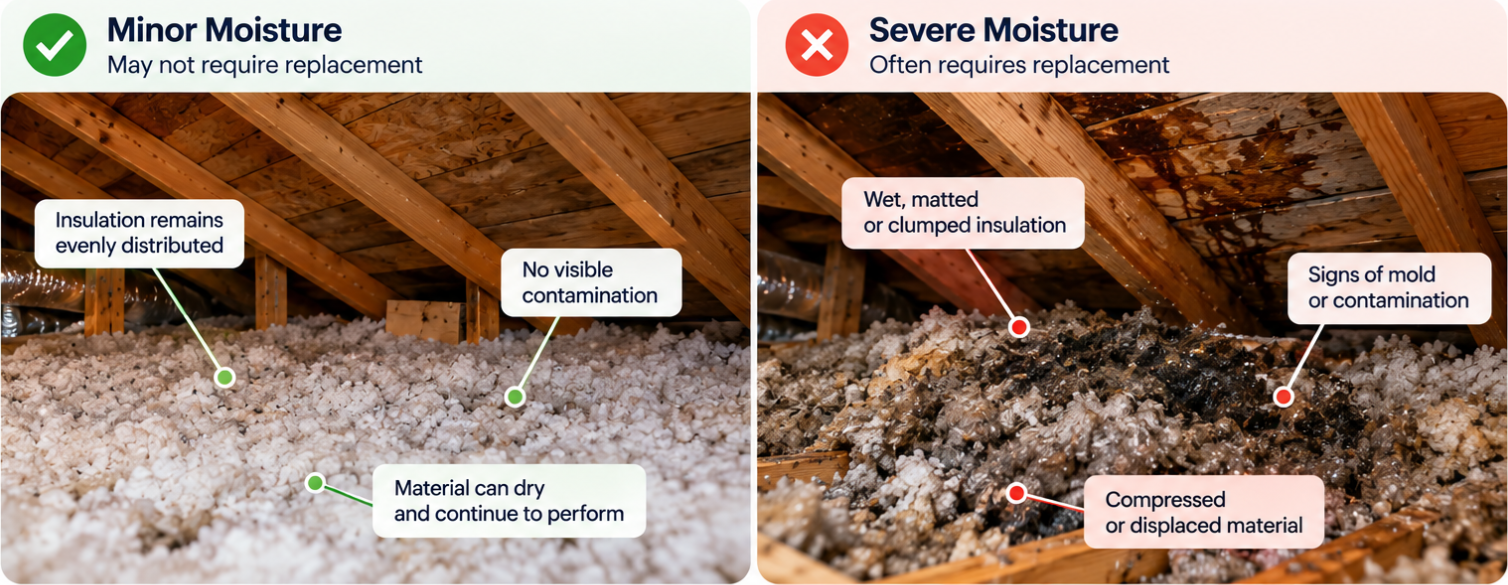
For example, insulation that remains evenly distributed and free from contamination may be treated differently from material that has become heavily saturated, displaced, or mixed with debris.
Homeowners should also consider what caused the moisture in the first place. Replacing the insulation without fixing the roof leak, plumbing issue, ventilation problem, or air leakage can simply recreate the same problem.
🔍 Signs Wet Attic Insulation May Need Attention
Several visible conditions can indicate that an attic requires closer inspection:
- 💧 Wet, matted, or heavily clumped insulation
- 🦠 Mold-like growth, staining, or unusual odors
- 🪵 Water stains on roof decking or framing
- 🌫️ Persistent condensation or damp areas
- 🐀 Pest debris mixed into affected insulation
These conditions do not automatically establish that every part of the attic needs to be removed. They indicate that the affected area and the source of moisture should be evaluated before additional insulation is installed.
🌴 Why Dania Beach Homes Need Special Attention to Moisture
Dania Beach homes experience a combination of high outdoor humidity, strong solar heat, and seasonal heavy rainfall. These conditions make attic moisture management particularly important.
Outdoor humidity by itself does not mean an attic will become wet. A properly functioning attic can remain dry even in a humid climate. Problems occur when humid air, rainwater, condensation, or plumbing moisture enters the attic and cannot be effectively controlled.
Roof penetrations and flashing are particularly important after periods of heavy rain. Even a relatively small roof leak can introduce water into insulation without being immediately visible from the living space below.
Bathroom exhaust is another issue worth checking. If a bathroom exhaust fan terminates inside the attic rather than outdoors, warm moisture-laden air can be introduced directly into the attic. Over time, that can contribute to condensation and localized moisture problems.
🏠 Common Causes of Wet Blow-In Attic Insulation
The source of moisture is often more important than the insulation itself. Before deciding whether to remove or replace material, the attic should be inspected for the conditions that allowed water or humid air to reach it.
| Moisture source | Typical attic impact | What should be checked |
|---|---|---|
| 🌧️ Roof leak | Localized wet or stained insulation | Roof decking, flashing and penetrations |
| 🚿 Plumbing leak | Wet areas around pipes | Supply lines, drains and fittings |
| 💨 Bathroom exhaust | Moist air entering attic | Exhaust duct routing and termination |
| ❄️ HVAC condensation | Damp insulation near equipment | Ducts, drain lines and equipment |
| 🌫️ Air leakage | Humid air entering from living space | Ceiling penetrations and gaps |
| 🌬️ Poor ventilation | Moisture may remain longer | Soffit and exhaust pathways |
This is why simply adding another layer of insulation is not always the correct response. The attic should be treated as a complete system rather than as a pile of insulation that can be replaced independently.
🌬️ How Ventilation Affects Wet Attic Insulation
Ventilation does not prevent every moisture problem, but it plays an important role in how the attic handles heat and air movement.
A properly designed attic typically needs adequate intake and exhaust pathways. Soffit vents provide intake air, while ridge vents, roof vents, or other designed exhaust openings allow attic air to move out.
Problems can occur when insulation blocks soffit intake areas or when baffles are missing or poorly positioned. In that situation, adding more insulation may actually make access to the underlying ventilation problem more difficult.
The same principle applies when dealing with wet insulation. Before installing replacement material, ventilation pathways should be checked and corrected where necessary.
If you are considering new material, reviewing completed blow-in insulation projects can also show how attic layouts and existing conditions can vary significantly between homes.
☀️ Can Florida Heat Dry Wet Blow-In Insulation
It is tempting to assume that Florida’s heat will simply dry out wet attic insulation. That is not a reliable approach.
An attic can become extremely hot while still having moisture-related problems. Drying depends on the type of material, the amount of water involved, airflow, temperature, and how long moisture remains trapped.
More importantly, allowing wet material to simply sit in a hot attic does not address the source of the moisture. If a roof leak continues or humid air is entering through an unsealed opening, the same problem can return.
The condition of the insulation should therefore be evaluated after a moisture event rather than assuming that high attic temperatures have solved the problem.
🧹 When Insulation Removal Makes More Sense
Removal becomes more appropriate when insulation is significantly damaged, contaminated, heavily saturated, or affected by pests or other debris. The objective is not simply to get rid of old material. It is to create a clean and accessible surface so the underlying attic conditions can be addressed.
Once the source of moisture has been corrected, the affected material can be removed and the attic cleaned before new insulation is installed. Professional insulation removal may be particularly useful when loose-fill material is distributed across a large attic area or when contamination makes manual handling impractical.
Removing material also makes it easier to inspect the roof decking, framing, penetrations, and ventilation pathways before the next insulation layer is installed.
🔧 Should You Add More Blow-In Insulation After a Moisture Problem
Adding new insulation can make sense when the existing material is dry, clean, evenly distributed, and otherwise suitable for continued use. However, moisture problems should be resolved first.
The sequence matters. Fixing the moisture source, addressing ventilation or air leakage, and evaluating the existing insulation should come before simply increasing insulation depth.
A homeowner who adds new material over a damaged area may temporarily hide the problem while making future inspection more difficult. That is especially important in an attic where access is already limited.
For homeowners evaluating whether additional material is appropriate, blow-in insulation installation should be considered as part of the overall attic condition rather than as an isolated upgrade.
🏡 How to Protect Blow-In Insulation in Attic
The best way to prevent moisture-related insulation problems is to address the conditions that allow moisture into the attic.
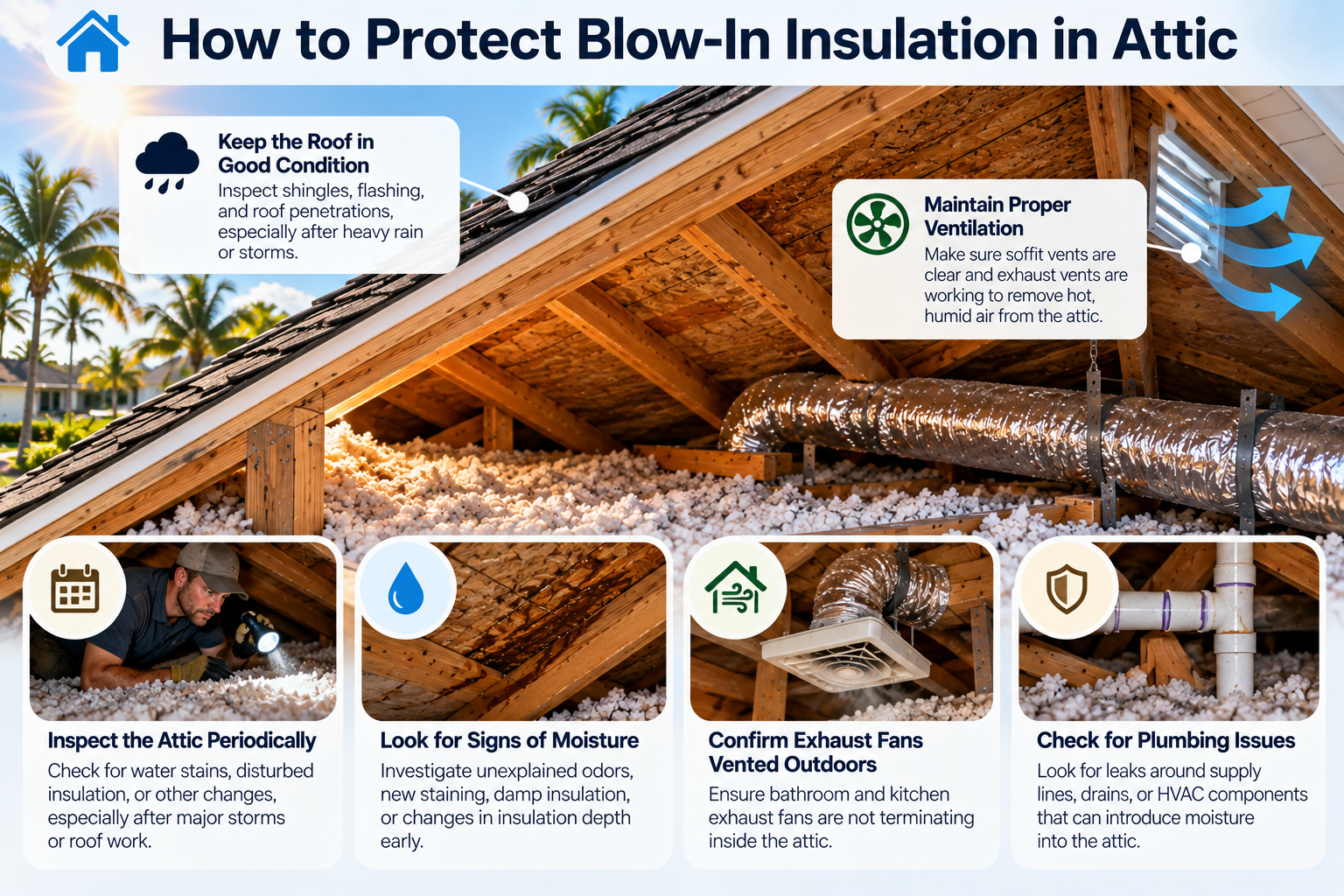
A homeowner does not need to inspect the attic every week, but periodic checks can help identify problems before they become extensive. After major storms or roof work, checking for water stains or disturbed insulation can also be worthwhile.
It is particularly important to investigate unexplained odors, new staining, visibly damp insulation, or changes in insulation depth. These signs can point to a moisture source that needs attention before it affects a larger section of the attic.
If an inspection identifies a problem that requires professional evaluation, homeowners can contact an attic insulation professional to discuss the condition and determine what work is actually necessary.
🌧️ Wet Blow-In Insulation Does Not Always Mean Starting Over
Wet insulation should not automatically be treated as a reason to replace the entire attic. The appropriate solution depends on the material, extent of moisture exposure, contamination, physical condition, and underlying cause.
For Dania Beach homeowners, humidity is part of the environment, but it is not necessarily the problem. The more important question is whether water or moisture is entering the attic and whether the existing insulation can continue to perform properly.
A careful evaluation can distinguish between insulation that can remain in place and material that needs to be removed. Correcting leaks, ventilation problems, and air leakage before installing new material is what helps prevent the same issue from returning.